.png)


He Started Getting His Nails Done
- Christine Lloyd-Newberry
- May 21
- 9 min read

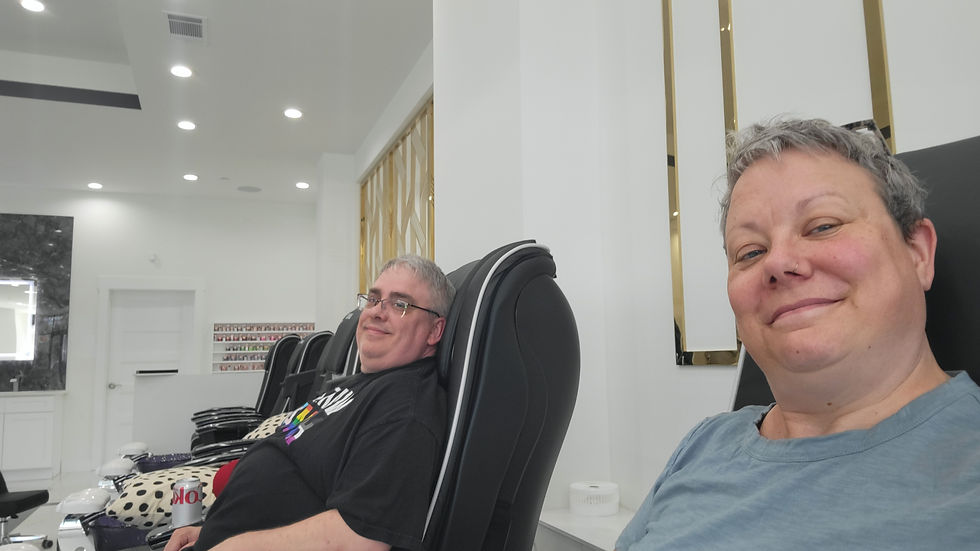
There's a nail salon about five minutes from my house where the staff knows my husband by name. They ask about him when I come in without him. They have opinions about his color choices. One of the technicians told us recently that his color choices were more fun and adventurous than mine. He's not wrong.
This is not how I imagined my burnout recovery story.
In November of 2023, I told my board chair I would be leaving. We didn't yet know what the timeline would look like, which is part of why we held the announcement. By January, the picture had come into focus — I would be stepping down with my last week being the end of July — and we brought the full board in. Nearly nine months from that first conversation to my last day. This choice reflected how deeply I cared about giving the organization every possible opportunity to find its footing without me. For the months that followed, they tried to fill the leadership role. By June, it was clear that wasn't going to happen — and more than that, it was clear that closing the organization was the right decision. By the time the board reached that conclusion, I had about a month left. The organizational wind-down was completed after I was gone.
Our move was a welcome one. It was also incredibly hard — not because of the distance, and not because of what we were moving toward. The hardest part was first leaving our son behind, and a close second was closing an organization I had desperately wanted to see succeed. When I became executive director, the organization was already built on an unrealistic foundation — the kind of infrastructure that depends entirely on one person's will to hold it together rather than systems strong enough to sustain it. I had spent my time there trying to change that. When it became clear that no one could be found to step into that seat, it wasn't a reflection of anyone's failure to try — we had some of the most amazing, committed staff and board who cared deeply about the organization. It was the organization finally telling the truth about itself. Deciding to leave was one thing. Leading it consciously towards its own ending — honoring what it had been while accepting what it could not become — was something else entirely. And the burnout I was carrying didn't wait politely for any of that to be finished before making itself known.
My burnout didn't start with this organization. It started much earlier than that. A traumatic childhood has a way of laying the groundwork — teaching you to over-function, to hold things together, to make yourself indispensable before you're old enough to know that's what you're doing. I spent years leading nonprofit organizations that were, structurally, never built to succeed. The non-profit sector runs on mission, goodwill, and the willingness of people who care deeply to absorb whatever the budget can't cover. That gap — between what the work demands and what the structure can support — gets filled by human beings. Usually, the ones who care the most. The ones who cannot bring themselves to let something they believe in fall apart on their watch. I was that person, more than once, in more than one organization. By the time I was leading this final wind-down, I wasn't just tired from this chapter. I was tired from all of them.
People talk about burnout as if it's just extreme tiredness. Like you need a good vacation and maybe a better morning routine. What they don't always say is that burnout can take up residence in your body in ways that feel almost surreal. At the height of mine, there were days I couldn't brush my own teeth. Not because I forgot. Because I simply could not make myself do it.
I was still going to work. Still leading. Still showing up every day for an organization and a mission I cared about deeply, while quietly carrying the knowledge that I was leaving — and trying to imagine who I would be on the other side. I couldn't. Being an executive director of a nonprofit — giving back to and being a part of the community in that way wasn't just what I did. It was who I was. I had an inkling in those final months of how hard that loss would be. That inkling didn't scratch the surface.
When the time came for me to walk out the door, I set an incredibly uncharacteristic boundary: I would not be available more than once a week after I left. Not because I was angry. Not because of anything anyone had done, or because I was holding a grudge. But because I knew myself well enough to know that if I left that door open any wider, I would walk back through it — and I would quite likely destroy myself in the process. That boundary was an act of survival, one I held to even after being told, "I hate you for this." It was one of the hardest things I have done, because the people and the mission still mattered to me enormously. They always will.
Through all of this, the one thing I kept doing — even on the worst days — was going to the nail salon.
I'm aware of how that sounds. A nail salon is not an accessible form of self-care (indulgence) for everyone, and I don't offer it as a prescription. But here's what I've come to understand about why it worked for me, even on days when almost nothing else did. When you are sitting in that chair, your hands are occupied, your feet are soaking, and, critically, you cannot answer the phone. You cannot check your email. You cannot respond to a text. Nobody can reach you. For someone who had spent years being reachable to everyone at almost all times, that enforced unavailability was less a luxury than a survival mechanism. It was an hour in which the world had to manage without me. And the world, it turned out, could.
And to be real, the nail salon was never about self-care. Not in the way that word gets used. Self-care has become its own kind of performance, another thing to optimize, another box to check on the way to being a person who has it together. What the nail salon was, at its most essential, was a place where I could simply exist without producing anything. No output. No value-add. No one served or led or held or answered. Just a body in a chair, being attended to, for an hour, because I had made one small decision to show up for myself in the only way I could manage that day. That's not self-care. It's just the bare minimum of not disappearing entirely.
I don't know exactly why that ritual survived when so much else didn't. Maybe because someone else was doing the work. Maybe because it was one of the few places I could show up exactly as depleted as I was, and it didn't matter. You sit down. You put your hands out. That's all that's required.
What I didn't realize at the time was that my husband was watching all of this. He was watching me disappear into the work, into the grief of it, into the particular loneliness of burnout that makes it hard to be reached even by the people who love you most. He couldn't fix what was happening. He couldn't shorten the timeline, lighten the load, or talk me out of how depleted I was. He watched me carry it. And when we finally made our move — when we landed in a new city and started building a new life — he made a quiet decision and joined me at the nail salon.
My husband started coming with me.
Not to fix anything. Not with a plan. He just started showing up, sitting down beside me, and getting his toenails painted.
Then one fingernail.
Then two.
You can do the math from there.
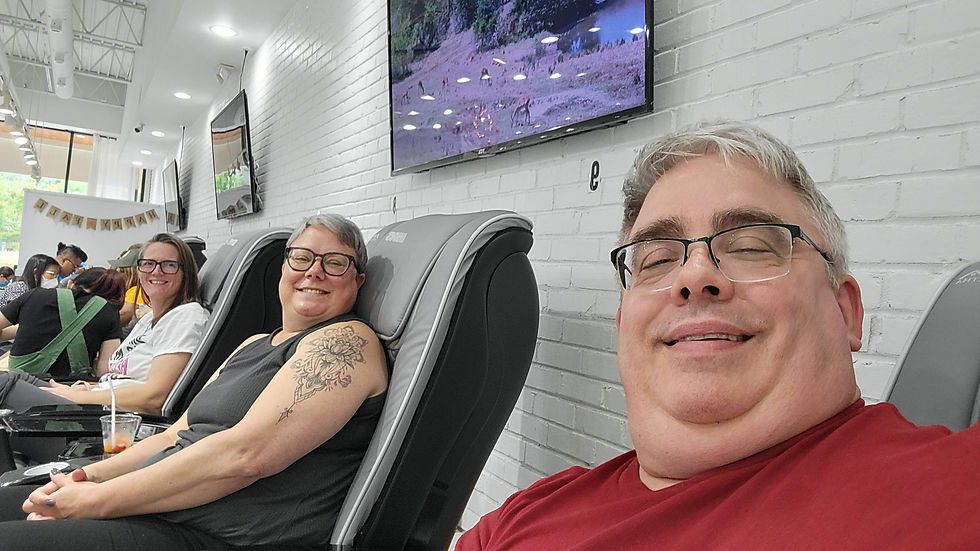
On my 50th birthday, he did something that still gets me when I think about it. He didn't plan a party, a trip, or a grand, public gesture. He called my best friend in Pittsburgh and invited her to fly to Atlanta. On my birthday, she showed up on my doorstep, suitcase in hand. The three of us went to the nail salon together. She and I went on to do a wine tour, to wander, to just be together the way that only happens when someone who truly knows you shows up in the same city. But the thing I keep coming back to isn't the itinerary. It's what he saw. He saw that I needed her. He saw that the three of us needed time together. And he quietly made it happen — without being asked, without making a production of it, without needing any credit for it. That is a different type of showing up entirely. That's someone who has been watching carefully enough to know what you need before you've found the words for it yourself.
He didn't try to talk me out of how I was feeling. He didn't offer solutions, timelines, or frameworks for getting better. He didn't point out that I was the one who had made the decision to take the job and subsequenly leave — that this was, in some sense, a chapter I had chosen to open and close. He didn't suggest that maybe I should be further along by now. He just kept showing up to the place I was already going and sitting down next to me.
That is not a small thing. That is, in fact, one of the most profound things another person can do for someone in burnout.
Because burnout is in part an isolation experience. It hollows out your sense of self and then makes you feel like you have to hide that fact. You learn to perform functioning even when you're not functioning. You learn to answer "I'm fine" so automatically that you sometimes forget it isn't true. And when you're still showing up to lead something every day, when the people around you are depending on you to hold it together through a transition, the gap between how you appear and how you actually feel grows, reaching enormous proportions.
Being seen — actually seen, without having to perform — is one of the most healing experiences available to a human being. And it almost never comes in the form we expect.
It didn't come to me as a grand gesture. It came as a man sitting in a pedicure chair getting his nails painted on a Tuesday afternoon because that's where I was.
I've thought a lot about what made that particular kind of support so powerful when so many other well-intentioned forms of support fell flat. He didn't need me to explain myself. He didn't need to understand the full scope of what I was moving through. He just needed to know: this matters to her, so I'll be here for it.
There's a kind of showing up that says: I see that you're carrying something heavy, and I'm not going to make you justify how heavy it is. That's what the nail salon became. A small, consistent, undramatic act of witness.
And over time, it became something else too — a shared ritual. A place where we were just two people taking an hour, sitting next to each other, not needing anything to be different than it was. In a season defined by endings, transition, and the particular grief of leaving a community and a purpose you'd built over decades, that hour mattered more than I can fully articulate.
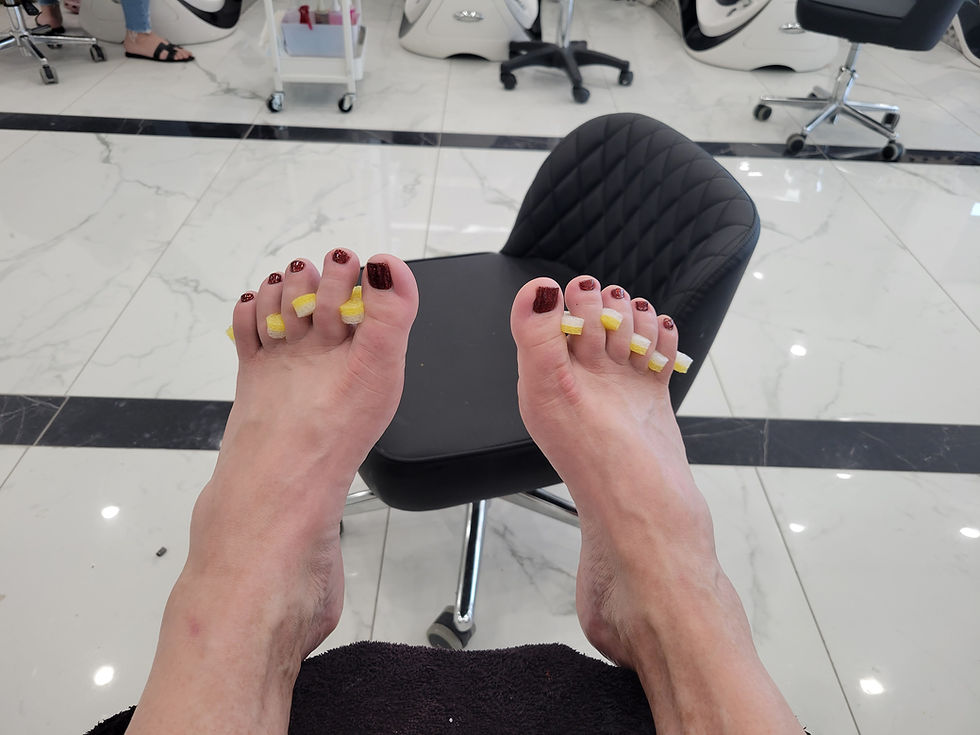
Now the staff at our new nail salon now knows my husband by name. They ask about him when I come alone. When we arrive together, they gather around to see what his latest color choice and pattern will be. They celebrate him — his choices, his creativity, the way he shows up authentically in a world that doesn't always make space for men to do that. He became a regular. At the nail salon. Because of me. Because of burnout. But also because he found a place where he could be exactly who he is, without apology or performance. And that matters too.
If you're trying to support someone in burnout, I want to offer you this: you don't have to understand it to show up for it. You don't have to fix it, reframe it, or wait until they seem more like themselves. You just have to be willing to sit down in the chair.
Even if it means getting your nails done.
Christine Lloyd-Newberry is a Life and Leadership Coach and Burnout Prevention Strategist with 30+ years of experience in leadership and human services. She holds an MPA, SHRM-SCP, and specialized training in Dialogue Education, Clifton Strengths, Appreciative Inquiry and Clinical Burnout. Through Emerge Empowered Coaching & Consulting, she works with high-achieviers and relentless givers navigating burnout recovery, life transitions, and values alignment. Visit emerge-empowered.com to book a complimentary discovery call.


Comments